Create a Small-Business Expense Category Glossary
Define a stable operational vocabulary so staff and reviewers use categories consistently across capture and export.
Published by the AI Expense Editorial Team. AI Expense is developed and published by EmuInbox.
Practical answer: Define a stable operational vocabulary so staff and reviewers use categories consistently across capture and export.
Category inconsistency often comes from unclear language rather than careless users. “Software,” “subscriptions” and “online services” can become overlapping labels unless the business explains what each means.
Start with decisions the categories must support
List the operational reports, searches and handoffs that use categories. Avoid copying a large chart of accounts into a capture screen when staff only need a smaller, understandable set.
Write one definition and examples for every label
State what belongs, what does not and where uncertainty should go. Use familiar purchase examples while making clear that an operational category is not tax advice.
- Assign an owner for glossary changes.
- Merge synonyms before adding new labels.
- Review uncategorized records for missing guidance.
Test consistency with real receipts
Give several reviewers the same sample documents and compare outcomes. Revise definitions when disagreement is systematic instead of relying on silent corrections.
Category glossary quality
- Every category supports a real business use.
- Definitions include positive and negative examples.
- Ambiguous cases have an escalation path.
- Tax treatment is not implied by operational labels.
Questions people ask in this situation
Should the glossary match accounting software exactly?
It should support the downstream mapping, but a simpler capture vocabulary may be easier for staff if the relationship is documented.
How often should categories change?
Only when real reporting or workflow needs justify the disruption. Stability improves search and comparison.
Where AI Expense fits
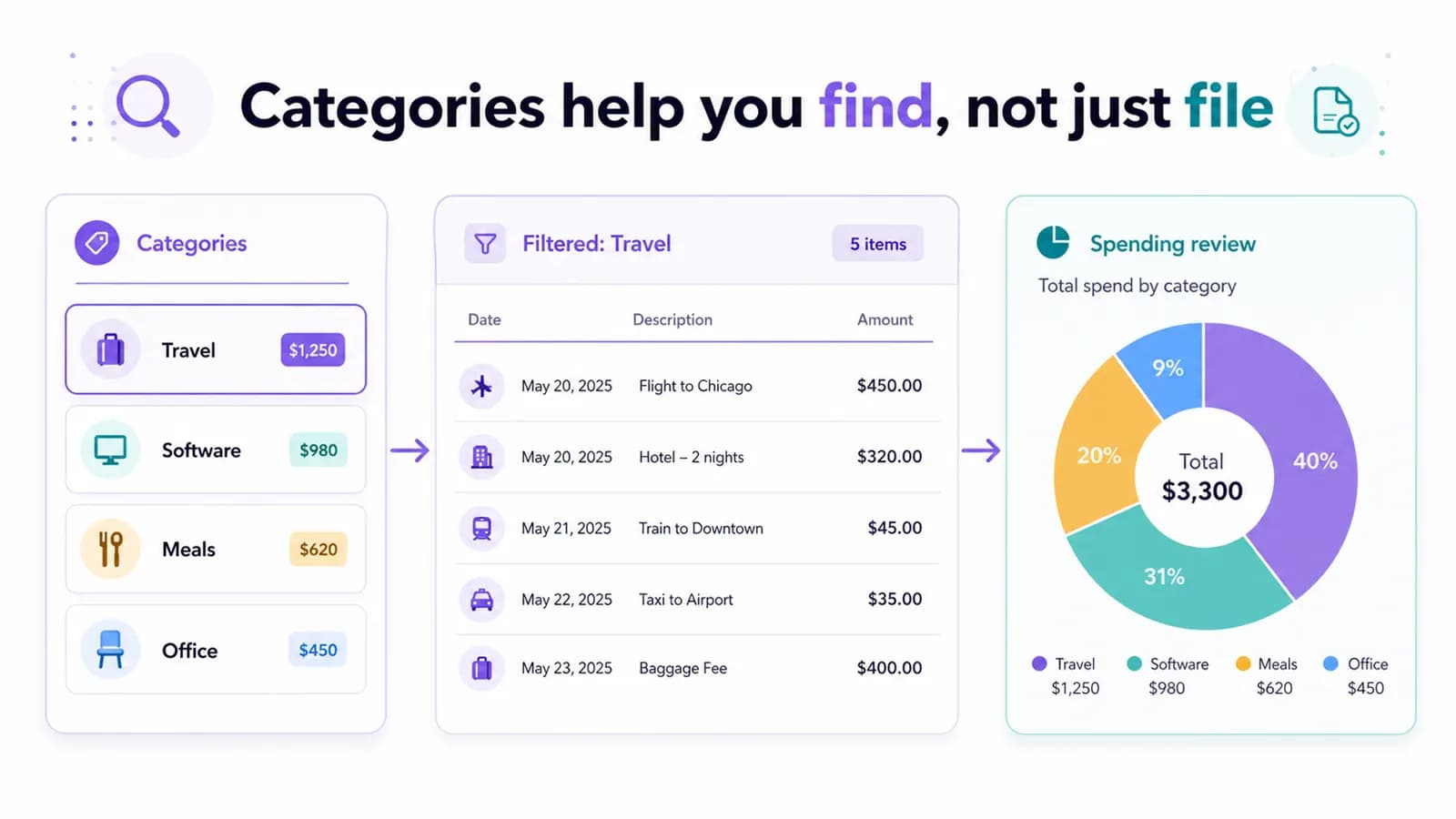
AI Expense categories and filters can apply the business vocabulary while original merchant and line-item data remain searchable for review.